


Warm, Welcoming Vibes in South Carolina
Courtesy Visit GreenvilleSC
South Carolina is relatively small — in terms of size, it ranks 40th out of the 50 U.S. states — but it punches above its weight. It packs a wallop with places to explore, activities to enjoy and food to eat. Here are five destinations for Palmetto State tours, including three on the coast, one in the middle of the state and one (almost) in the mountains.
Greenville
“So many people don’t understand that South Carolina has mountains,” said Tim Todd, executive director of Upcountry South Carolina, a six-county tourism district. “The beaches are spectacular, but I love being in the foothills of the Blue Ridge Mountains.”
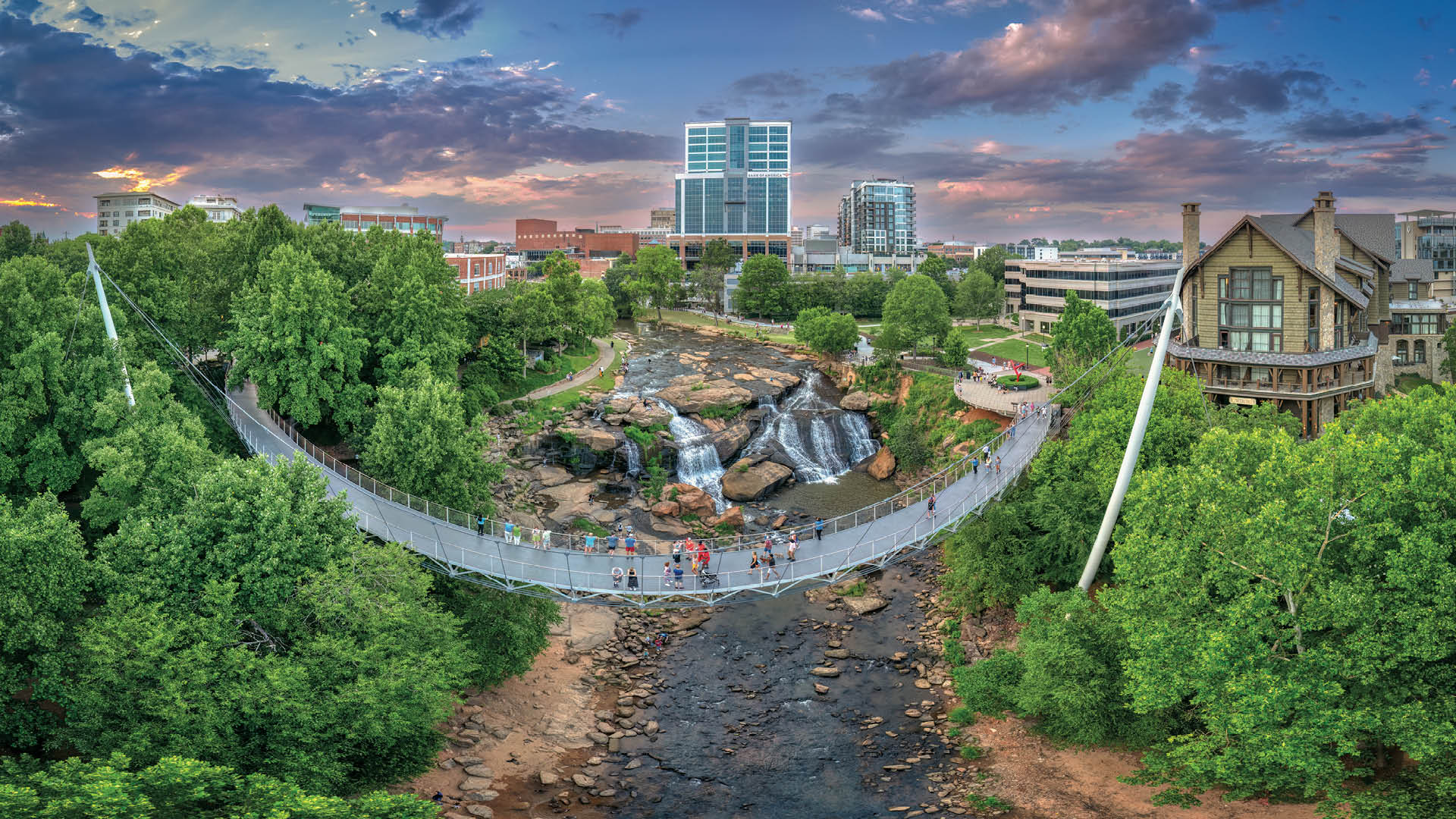
Greenville alone is a solid tour destination. For decades, Greenville thrived on textile mills powered by the Reedy River until the textile industry evaporated in the late 1900s. It took many years, but downtown Greenville burst back in a renaissance of river restoration, public gardens, a minor league ballpark, an arena, restaurants and a much-photographed 355-foot-long, 12-foot-wide curved suspension bridge over a waterfall.
The Upcountry History Museum, a Smithsonian Affiliate, illuminates the material, social, cultural and spiritual life of the Upcountry. Part of that story explains the region’s pivotal role in the American Revolution at Kings Mountain and Cowpens battlefield sites.
A different education awaits at the Greenville Zoo. At 14 acres, its manageable size fits nicely in an itinerary, especially combined with a bridge walk at Falls Park on the Reedy. Zoo animals include Sumatran orangutans, red pandas, Chilean flamingos and a southern screamer, a vocal South American bird. A popular activity is hand-feeding the zoo’s gangly giraffes.
For light food and specialty drinks, groups can head to Six & Twenty Distillery, which takes its name from a legend involving a Choctaw woman, an English trader, a love affair and a daring escape from danger. The distillery offers tours on Saturdays. Food, libations and playtime are the draw at Group Therapy Pub & Playground, an indoor facility with everything from wacky mini golf and digital darts to duck-pin bowling, table tennis and axe throwing. It’s a great choice for an on-your-own tour night.
Columbia
Columbia, South Carolina’s capital city, says it is “big, but not too big.” It’s certainly vibrant. Beyond being the state capital, it is home to the University of South Carolina and two historically Black colleges and universities — Benedict College and Allen University — highly regarded museums, a major zoo, four historic house museums, a national park and more than 30 barbecue joints.
The South Carolina State Museum, the state’s biggest, houses more than a million pieces of art, artifacts, fossils and scientific objects. It showcases all of South Carolina, from gigantic shark teeth and Civil War swords to colorful folk art and historic telescopes. The Columbia Museum of Art is South Carolina’s only art museum with an international collection. It takes the long view of human history with items as diverse as Chinese ceramics from the Tang Dynasty (618-907) and a Charles Willson Peale portrait of Gen. George Washington.
Historic Columbia manages four house museums, and one has a special twist. The Woodrow Wilson Family Home, where President Woodrow Wilson lived as a teenager, is distinguished by what it houses today: the Museum of the Reconstruction Era. Historic Columbia says it is the nation’s only museum dedicated to the troubled and troubling decades after the Civil War.
Columbia boasts two substantial escapes to nature. First is Riverbanks Zoo & Garden along the Saluda River, home to more than 3,000 animals in natural habitat exhibits where moats, water and light create an environment free of bars and cages. The 70-acre Riverbanks Botanical Garden complements the animal kingdom. Second is Congaree National Park, the largest intact expanse of old growth bottomland forest in the Southeast, with 26,000 acres. Many visitors explore by canoe and kayak, but walkers enjoy 2.4 miles of boardwalk and 25 miles of trails.
Myrtle Beach
Myrtle Beach is South Carolina’s playground. It’s part of a 60-mile-long arc of beautiful Atlantic coastline, chock full of beaches, boardwalks, live entertainment theaters, nature cruises, freshly caught seafood and golf — lots of golf.
Playing traditional golf on one of the Grand Strand’s 100-plus courses isn’t a normal group tour activity, but what about miniature golf? The first mini-golf course was built in Myrtle Beach in 1930, and today it’s the “Mini Golf Capital of the World,” with more than 30 courses. Dinosaurs, pirates, jungles and other themes abound, and a new kid on the block called PopStroke makes mini golf look like a country club course that shrank in the clothes dryer.
Getting in the water is fun, but getting on the water can be even more fun with a Myrtle Beach cruise. The 70-foot Barefoot Queen riverboat can carry 130 passengers on Intracoastal Waterway trips, and various operators offer several themed trips. Groups can opt for a wildlife and marsh eco tour, a bird watching tour, a history cruise, a sunset cruise or even a ghost story cruise.


Landside entertainment is abundant in large-scale professional theaters. Stage entertainment took root in Myrtle Beach in 1986 when Calvin Gilmore opened the 1,000-seat Carolina Opry Theater. Four decades and 10,000 shows later, it’s still going strong, along with several other venues. Among them are the Greg Rowles Legacy Theatre, the Alabama Theatre, Legends in Concert and Pirates Voyage Dinner & Show. Pirates Voyage brings water indoors because the performance revolves around a 15-foot-deep lagoon where pirate acrobats and others perform splashy stunts.
Charleston
As South Carolina’s oldest city, Charleston has had centuries to build civic pride. To listen to a Charlestonian, this city that occupies a peninsula jutting into an impressive harbor is the center of the universe. Some proclaim Charleston is “where the Ashley and Cooper rivers unite to form the Atlantic Ocean.” More believable is how its collection of historic downtown churches earned it the nickname of “The Holy City.”
Beyond its beautiful churches, a row of 13 townhouses painted in Caribbean pastels became one of its most photographed scenes. Collectively known as Rainbow Row, all but one of the houses were built in the 1700s for merchants. They survived the ravages of the Civil War and deterioration into slums. Their resurrection — helped by coats of yellow, blue and pink paint — made them symbols for the city.
The more modern International African American Museum began gaining attention in 2023. Its location carries great weight. It is at Gadsden’s Wharf, the spot where historians say 40% of all enslaved Africans landed in what became the United States. Slavery is a major focus, but the museum’s scope is the massively larger story of African American culture and history overlaid on the global African diaspora.
Other historical attractions include The Charleston Museum, the oldest museum in the U.S.; the gardens of Middleton Place; Fort Sumter in Charleston Harbor, whose bombardment launched the Civil War; and Patriot’s Point, where the mighty aircraft carrier USS Yorktown is open for tours.
Charleston Harbor cruises, which often include dolphin sightings, and the South Carolina Aquarium are two opportunities for encounters with nature. A hit at the aquarium is the Zucker Family Sea Turtle Recovery, a hospital for injured sea turtles, whose average stay is nine months. A bonus at the aquarium is the patio with a clear view of the Arthur Ravenel Jr. Bridge over the Cooper River. When it opened in 2015, it was the longest cable-stayed bridge in North America.
Beaufort
Even if someone has never been to Beaufort before, they have probably seen it. The coastal community has been integral to movies such as “Forrest Gump,” “The Big Chill,” “G.I. Jane,” “The Prince of Tides” and “The Great Santini” — the last two of which were based on novels by local legend Pat Conroy.
Beaufort is on Port Royal Island, one of the largest of the Sea Islands on the Southeastern coast, and the city’s entire downtown is a National Historic Landmark District. That’s one reason touring the oak-shaded streets is so enjoyable. French, Spanish and English explorers all saw the area’s beauty and potential. Founded as an English colony in 1711, Beaufort is South Carolina’s second-oldest city. Only Charleston, established in 1670, is older.
Downtown tours should include the 1911 fire station that now houses a piece of the Reconstruction Era National Historical Park. It explains Beaufort’s place in that complicated period of American history. Another park component is a grove of moss-draped live oaks where 5,000 formerly enslaved people heard the first reading of the Emancipation Proclamation in the Southern states and where the first formerly enslaved men became Union soldiers.
In current times, Beaufort has gained recognition as one of America’s best small towns for art. Groups can visit Beaufort River Glass for handmade glass items; Atelier Off Bay for works from 14 Southeastern artists; the Beaufort Art Association for its focus on regional artists; and Thibault Gallery and Rhett Gallery for local arts and crafts.
Two more tour prospects offer quite diverse experiences. One is the serious and inspiring Parris Island, where civilian recruits become Marines and where the Parris Island Museum traces U.S. Marine Corps history and tradition. The other is the totally frivolous Kazoobie Kazoo Factory & Museum. During a visit, groups will learn the mystery of the kazoo, see how kazoos are made and hum along on the kazoos that come with every tour.


Tom Adkinson
Nashvillian Tom Adkinson continues his multi-decade career in travel journalism and travel publicity as an independent writer with time to roam. He particularly enjoys researching stories that include history, interesting personalities and the outdoors, especially destinations where trout hang out. He is a Marco Polo member of the Society of American Travel Writers.
You May Also Like



About Us

We're The Group Travel Leader, America's leading experts on all things group travel. Find hundreds of articles, podcasts and other free resources for your group travel program here.
The Latest Issue
Stay Connected!
Get the Group Travel Minute e-newsletter twice a month.