


The Heartland’s Main Street Magic
Courtesy Visit Pella
Small towns don’t announce themselves with a glittering skyline. Instead, they reveal their charms with lively downtowns, historic squares, boisterous annual festivals and small signature museums. These destinations have nourished their past and preserved their appeal by building on specific and strong attractions like an art-filled lakefront, a well-preserved history of oil and outlaws, and a president’s front porch.

Here are four Heartland towns that offer well-rounded, entertaining experiences for groups.
Lima, Ohio
Outlaws, oil barons and art — Lima, Ohio, can claim a little fame for all of the above. Settled for farming in 1838, the city was on track to become one of the world’s largest steam-engine manufacturers with the founding of Lima Locomotive Works in 1879. But it was really put on the map in 1885, when mill owner Benjamin C. Faurot struck crude oil while drilling for water. In less than a year, Lima was a boom town, and the field bearing its name was the nation’s leading producer of oil. By the following year, astonishingly, Lima was considered the largest oil producer in the world.
That history lives on at the Allen County Museum, where the transportation wing houses a 1925 Shay locomotive, a Lima City Street Railway motorman’s cab and thousands of railroad photographs. Elsewhere on campus, groups can wander a reconstruction of the city’s “Golden Square,” tour the 1893 Victorian MacDonell House, explore a restored log cabin and see an exhibit about the Civil War camp that was briefly located in Lima in 1862.
And then there’s the outlaw. A young John Dillinger served eight years for an attempted grocery store robbery before being paroled in 1933, only to be almost immediately arrested for a botched attempt on a bank. Awaiting trial in Lima, he was freed by three accomplices and began a nationwide crime spree that would finally end with his death during an FBI shootout the following year. The museum contains an exhibit chronicling his exploits.
In Lima’s historic downtown, ArtSpace/Lima fills a turn-of-the-century building with rotating gallery shows and a popular summer concert series called Rally in the Square. Just a short walk away, the Veterans Memorial Civic and Convention Center anchors the cultural district with Broadway-style touring shows and symphony performances. And no group visit would be complete without a stop at Kewpee Hamburgers, a local favorite that has been pleasing hungry diners since 1928.
Pella, Iowa
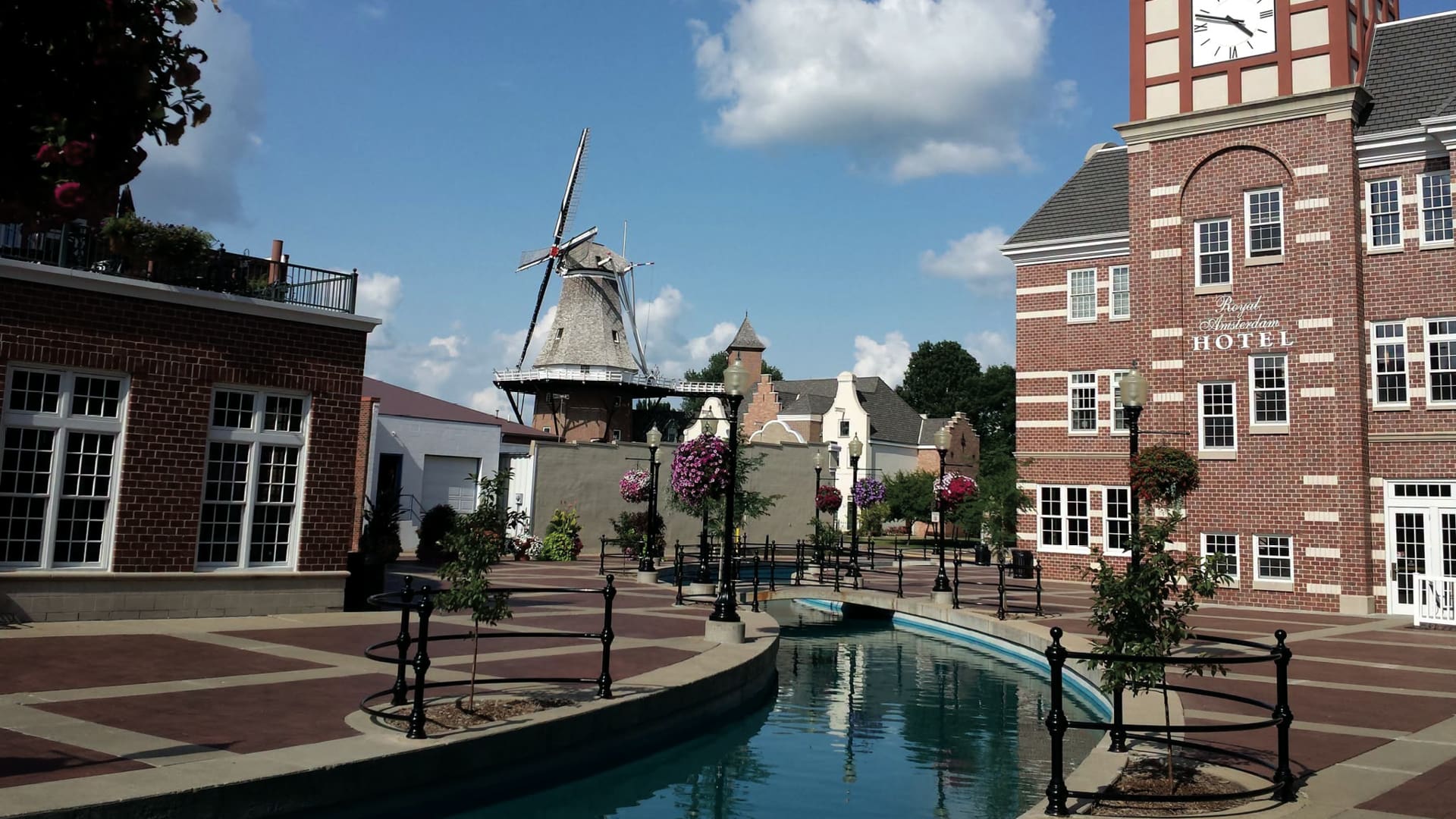
Most Americans are familiar with the name “Pella” because of the window brand that bears the Iowa town’s name — they’ve been made there since 1937. But there’s much more to the town of 11,000, which is located about 40 miles east of Des Moines, the state’s capital. A contingent of about 800 religious dissenters from the Netherlands settled on the divide between the Des Moines and Skunk rivers in 1847, and Pella still retains a strong Northern European flavor.
“Our town really is steeped in tradition,” said Ann Frost, executive director of Visit Pella. “Pella is a completely different community. We have held onto our Dutch traditions and Dutch heritage very strongly. Our whole downtown is Dutch architecture. We have the tallest working windmill in North America. It was built in the Netherlands, disassembled and brought over here. It works, it grinds grain, and one of our local bakeries uses the grain.”
Groups can tour the 126-foot Vermeer Windmill at the Pella Historical Village, along with the grand Scholte House — built in 1847 by Pella’s founder for his wife, Maria.
Another highlight is the boyhood home of Wyatt Earp, which was built in 1855. Admission includes The Wyatt Earp Experience, a self-guided audio tour chronicling the childhood, career and legacy of the Wild West’s most legendary lawman and icon of the gunfight at the O.K. Corral. The village also has a traditional prairie sod house and a musical Klokkenspel, which plays five times each day. Pella’s Dutch traditions burst into bloom during Tulip Time, when more than 350,000 of the colorful bulbs flower throughout the town.

Independence, Missouri
The “Queen City of the Trails,” Independence, Missouri, boasts a prime location along the south bank of the Missouri River and along the path of three of the nation’s most famous westward trails: the Oregon, California and Santa Fe. The frontier trading post quickly grew, and a century later had another claim to fame as the boyhood (and later retirement) home of the 33rd President of the United States, Harry S. Truman.

Now a thriving suburb of Kansas City, Independence is just a few minutes away from downtown, Country Club Plaza, the Nelson-Atkins Museum of Art and both Arrowhead and Kauffman stadiums, home to the Chiefs and Royals football and baseball teams. Visitors will want to check out the National Frontier Trails Museum to learn about the experiences of the hundreds of thousands of pioneers who risked everything for the chance of a new life in the West, as well as the 1827 Log Courthouse and the 1859 Jail Museum.
No visit to Independence would be complete without a tour of the Harry S. Truman Presidential Library and Museum. Despite never graduating from college, this farmer, failed haberdasher and Army soldier became a keen military leader and politician who led the nation through the end of World War II and tirelessly promoted civil rights for all Americans. The library chronicles Truman’s personal and professional life and features a rotating series of special exhibitions.
Galena, Illinois
From its movie-perfect Main Street lined with red brick buildings to the scenic bluffs in Apple River Canyon State Park, Galena, Illinois, oozes classic Midwestern charm. Located just 134 miles from Chicago in the northwestern corner of the state, Galena routinely receives accolades, including being named one of the “20 Most Beautiful Small Towns Across the U.S.” by Travel + Leisure magazine.
“Galena is so rich in art and history, with beautifully preserved 19th-century architecture as well as outdoor adventure,” said Fallon Oldenburg, vice president of marketing for Galena Country Tourism. “When visitors come, they don’t just see a destination. It’s like an experience altogether, and experiential tourism is really huge and important for making memories and for overall well-being.”
Visitors can hop aboard a cheery red trolley for a one-hour narrated tour showcasing the architectural and historical highlights from when the town was a riverboat and lead mining powerhouse. Civil War general and 18th President of the United States Ulysses S. Grant moved his family to Galena in 1860 to work in his father’s store, and when he returned a war hero, the town’s grateful citizens gifted him the stately Italianate home he had previously rented. The U.S. Grant Home State Historic Site is open for tours Wednesday through Sunday.


Cynthia Barnes
Cynthia Barnes is a Colorado-based travel writer who has written for the Boston Globe, Food & Wine, Toronto Star, and National Geographic, among other publications. She loves dives (both scuba and bars), baseball (Cubs), spicy food, and exploring the world.
You May Also Like

About Us

We're The Group Travel Leader, America's leading experts on all things group travel. Find hundreds of articles, podcasts and other free resources for your group travel program here.
The Latest Issue
Stay Connected!
Get the Group Travel Minute e-newsletter twice a month.