


Kentucky’s Bluegrass Legacy
Courtesy KY Dept. of Tourism
There’s a certain allure to long-established locales. Sites with history have decades of stories to tell — often with messages that still resonate, in one way or another, with life today. From early homesteads and settlements to landmarks commemorating people and ways of the past, Kentucky’s historic sites preserve snapshots of the state’s core foundations.

Exploring these sites provides a meaningful way to learn about bygone points in time. Strolling their grounds and visiting their carefully crafted exhibits also offers a window into the people, both famous and relatively unsung, whose lives shaped Kentucky’s story in lasting ways.
Dinsmore Homestead
Burlington
Completed in 1842, Dinsmore Homestead preserves the historic Greek Revival-style home of James Dinsmore, a New Hampshire native and former Louisiana plantation owner who relocated to Kentucky to establish a diversified farm. At its height, the property just west of Burlington included more than 700 acres, with fields of corn, oats and hay alongside vineyards and pastures of sheep and goats.
The home has been operating as a museum since 1988, and nearly everything displayed in the main house belonged to the Dinsmore family. Rooms are outfitted with period furnishings, clothing, china, antique toys and more, providing a glimpse into the daily life of well-to-do 19th-century property owners. Highlights include the Dinsmores’ 2,000-volume library and an assortment of nearly 90,000 pages of letters and journals.
Outside the main home, the homestead’s original, preserved outbuildings offer a glimpse into the starker antebellum existence faced by the farm’s working class, including its tenant farmers and enslaved laborers. As a registered site on the Kentucky African American Heritage Trail, the property’s tours honestly depict its slave history, spotlighting the contributions of enslaved workers to Kentucky’s early agricultural economy.
Shaker Village of Pleasant Hill
Harrodsburg
Once home to the third-largest Shaker community in the United States, Shaker Village of Pleasant Hill near Harrodsburg preserves 34 surviving buildings — built between 1809 and 1875 — plus a host of original furniture, tools, crafts and artifacts that, together, detail the Shakers’ commitment to a simple life rooted in deep spirituality.
Groups can enjoy both guided and self-guided tours of many of the property’s most iconic buildings, including the Meeting House, the Shakers’ central place of worship, and several carefully preserved lodging houses. Guides provide insights into the Shakers’ unique 19th-century sensibilities: Celibate, pacifist and deeply devout, they believed in equality for all races. Their lives focused on simplicity and utility, from their clothing to their furniture and tools.
While on the property, visitors can dine on traditional Southern fare at The Trustees’ Table restaurant and even stay overnight in one of the property’s 72 guest rooms, suites or private cottages, all outfitted in the clean, modest lines of Shaker-inspired furnishings.
The village’s working farm regularly offers animal meet-and-greets and workshops on sustainable agriculture. A bit farther afoot, the property’s 3,000-acre natural preserve includes free trail access to a diverse ecosystem of native prairies, woodlands and watersheds teeming with native wildlife.
My Old Kentucky Home State Park
Bardstown
Traditionally described as the inspiration for Stephen Foster’s famed 1853 ballad, “My Old Kentucky Home” — Kentucky’s state song — the Federal Hill estate in Bardstown is better known today as My Old Kentucky Home State Park.
Built between 1812 and 1818 as the home of John Rowan, a U.S. senator, judge and distant cousin of Foster’s, the three-story mansion weathered a cholera outbreak, an 1841 fire and divisive Civil War-era political tensions while serving as the hub of a thriving plantation that spanned some 1,300 acres at its peak.

In 1923, the state of Kentucky assumed ownership of the estate and declared it a state park. Inside, three-quarters of the home’s furnishings remain period originals, including fine art, antique furniture and personal artifacts once owned by the Rowan family.
During the summer, the grounds host live performances of the “Stephen Foster Story,” a long-running outdoor musical focused on Foster’s creation of his iconic songbook. The property also routinely offers special seasonal events, from candlelight holiday tours to murder mystery dinners, ghost tours and locally inspired bourbon tastings.
Fort Boonesborough
Richmond
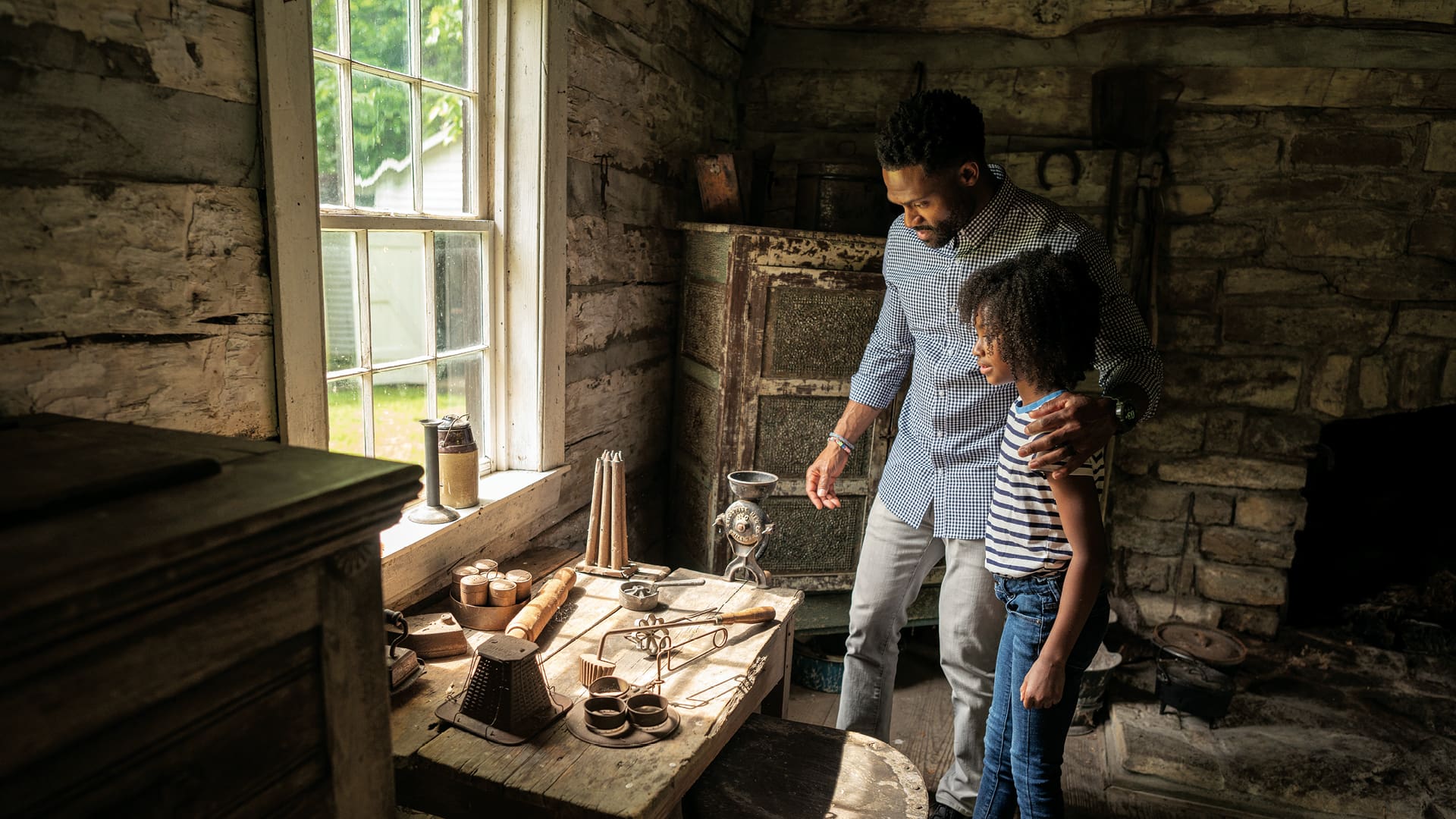
Built in the style of the historic settlement established by Daniel Boone in 1775, Fort Boonesborough in Richmond invites visitors to explore what life might have been like in an early frontier fortification. The replica fort includes 16 furnished log cabins and four corner blockhouses, staged as though they may have looked when pioneers took shelter there. The footprint of the original fort site, roughly a half mile away, is accessible by trail.
Skilled artisans dressed in period garb enhance the site’s historic feel through hands-on demonstrations of settlement crafts like broom making, candle making, weaving and blacksmithing. During special events — such as the 1778 Siege of Fort Boonesborough reenactment each September — guests can try their hand at pioneer pastimes, like ax throwing and churning butter.
Knowledgeable on-site docents can guide groups through the fort year-round, sharing history-filled stories about pioneer life along the Kentucky River-area settlement during its earliest days.
parks.ky.gov/explore/fort-boonesborough-state-park
Abraham Lincoln Birthplace National Historical Park
Hodgenville
Though he achieved everlasting fame as the nation’s 16th president — and as one of its most legendary statesmen and orators — Abraham Lincoln came from very humble beginnings. Born in a log cabin near present-day Hodgenville, young Abe spent his earliest years frolicking in the fields on what was then called Sinking Spring Farm.
Today, visitors can view the very spring that gave the farm its name before strolling up the long column of ornate, granite and marble steps — 56 in all, one for each year of Lincoln’s life — leading to the site’s Greek-inspired, Beaux Arts-style Memorial Building. Inside, a replica log cabin recalls the small, modest wood structure in which Lincoln was born.
Park staff offer a host of guided tours and ranger-led programs. At the park’s visitor center, a 15-minute introductory film helps set the context for Lincoln’s early Kentucky roots and his later impact on the nation.


Robin Roenker
Freelance writer Robin Roenker reports on travel, healthcare and higher education for regional and national outlets including Group Travel Leader, AARP, Southern Living, USA TODAY and more. She lives in Lexington, KY, with her husband, three sons, and very energetic dog, Ollie.
You May Also Like
About Us

We're The Group Travel Leader, America's leading experts on all things group travel. Find hundreds of articles, podcasts and other free resources for your group travel program here.
The Latest Issue
Stay Connected!
Get the Group Travel Minute e-newsletter twice a month.