


Alabama Moments and Milestones
By Art Meripol, courtesy Alabama Tourism
Like all states, Alabama’s story has been shaped by the richly layered history of its people. From ancient Indigenous tribes and early settlers to people in more modern times who fought bravely for greater civil rights in an era of discrimination, each generation has left a heritage worth preserving and retelling.

The sites showcased here offer the chance to step back into history — and to experience, if just for a moment, the challenges, triumphs and daily joys witnessed by inhabitants of Alabama’s bygone eras.

Fort Morgan
Gulf Shores
Constructed between 1819 and 1834, Fort Morgan stands sentinel on Alabama’s shoreline at the mouth of Mobile Bay. Having played a pivotal role in the Civil War — including, especially, during the 1864 Battle of Mobile Bay — the fort was also actively used by the U.S. military during the Spanish Civil War and both World Wars.
Today, visitors can tour the fort’s bastions, tunnels, cannons and lookouts and imagine soldiers of various eras stationed there. Guests can explore the expansive grounds through self-guided tours or ranger-led walks. Living history experiences, including artillery demonstrations and portrayals of daily life, are offered during special events. The site also includes access to beachfront nature areas, a gift shop, a pier and a boat launch.
Situated just 20 or so miles from Gulf Shores, the site’s well-preserved fortifications and engaging programs make it ideal for groups. “Set along the shores of Mobile Bay, Fort Morgan Historic Site offers travelers a compelling mix of history and coastal scenery,” said Michelle Russ, vice president of sales at Gulf Shores & Orange Beach Tourism.
Groups can also opt to tour Fort Gaines on nearby Dauphin Island, which is accessible via a 40-minute ride on the Mobile Bay Ferry. Constructed between 1821 and 1853, Fort Gaines also played a pivotal role in the Civil War’s Battle of Mobile Bay. The site features a museum with uniforms and other artifacts, a blacksmith shop and original cannons.
Both forts offer an easy day trip — and a fun, history escape — for groups enjoying a beach stay in Gulf Shores or nearby Orange Beach.
Moundville Archaeological Park
Moundville
Members of an early Mississippian culture occupied the areas around Moundville Archaeological Park from roughly 1000 to 1450. There, approximately 800 years ago, they built nearly 30 massive earthen mounds arranged around a central plaza. During the civilization’s peak, each mound would have served as a platform for homes or for civic and ceremonial structures.
At one time, Moundville represented a 300-acre village that comprised the Americas’ largest city north of Mexico. Today, groups can tour the site, preserved and managed by The University of Alabama Museums, and trace the figurative blueprint of one of America’s oldest communities.
At Moundville, visitors can “walk among the mounds, explore living traditions through contemporary Native art and enjoy the scenic Black Warrior River landscape,” said Jessica Dees, museum education outreach coordinator and festival director at the Moundville Archaeological Park.
Groups can enjoy tours of the site, which is located just 13 miles south of Tuscaloosa. In addition to remnants of the mounds, the site also includes the Jones Archaeological Museum, home to exhibits and artifacts that speak to Moundville’s past.
“The on-site museum interprets the people who lived there, their artistry, trade networks, religion and archaeology,” said Josh Rivers, director of community partnerships and group tour experiences with Visit Tuscaloosa. “It turns grassy mounds into a vivid story rather than ‘just hills.’”
Each October, the site hosts an annual Native American Festival featuring live demonstrations, artists and performances. Moundville’s enduring appeal stems from the fact that “you can still see the city plan in the landscape,” Rivers added. “Instead of reading about an ancient urban center in a museum case, you’re standing where it existed.”
Birmingham Civil Rights District
Birmingham
During the 1950s and 1960s, some of the most significant moments of the American Civil Rights Movement played out within a six-block district in downtown Birmingham. Landmarks within the district include the 16th Street Baptist Church, where a 1963 bombing tragically killed four young Black girls, and Kelly Ingram Park, where peaceful Civil Rights protesters —including children — were met with resistance by police with dogs and fire hoses.
Images from these confrontations were broadcast worldwide, helping shift public opinion against long-held Southern segregation tactics and accelerating the push for passage of the Civil Rights Act in 1964. Today, both 16th Street Baptist Church and Kelly Ingram Park, now home to statues depicting the Civil Rights struggle in Birmingham, are open to public tours.
The district also includes the Birmingham Civil Rights Institute, which chronicles the struggle for racial equality through immersive exhibits and compelling oral histories. Permanent exhibits there include examples of “Whites Only” water fountains; firsthand accounts of the violence and intimidation that reinforced segregation for decades; and personal histories of Birmingham leadership, including figures like Fred Shuttlesworth, who helped organize the Birmingham Campaign for Civil Rights in 1963.

“The history made here didn’t just shape Birmingham, it helped shape the world,” said Dan Williams, president and CEO of the Greater Birmingham Convention and Visitors Bureau. “When groups visit Birmingham’s Civil Rights landmarks, they’re not just seeing history; they’re gaining perspective on leadership, resilience and how that legacy continues to move our city forward today.”
While in Birmingham, groups can also view the historic marker on Sixth Avenue commemorating Martin Luther King Jr.’s writing of his famous “Letter from a Birmingham Jail.” On Fifth Avenue, the A.G. Gaston Motel, which served as a headquarters of sorts for King and others, is being restored to serve as a centerpiece of the multisite Birmingham Civil Rights National Monument. The hotel is expected to reopen to tours in 2028.
The entire Civil Rights district is “very walkable, with multiple sites in close proximity,” said Shawna Faniel, senior national sales manager for Alabama Tourism. “The area delivers strong educational value for groups of all ages.”
Burritt on the Mountain
Huntsville
Nestled on the crest of Round Top Mountain above Huntsville, Burritt on the Mountain includes scenic views plus a meticulously reconstructed historic park with six 19th-century log homes, a barn, a church, a blacksmith shop and other assorted outbuildings.
Living history interpreters in period dress invite visitors to experience daily farm life as it may have been during the 1800s through demonstrations and hands-on, barnyard-based activities.
“Burritt on the Mountain, Huntsville’s first museum, was established in 1955,” said Elizabeth Jones, the site’s marketing director. “It preserves not only Dr. William Burritt’s home, but also several other historic buildings that have been moved to the property. These buildings share the story of rural life as it was experienced in the Cumberland Plateau area from around 1810 until the turn of the century.”
Groups can stroll along the site’s many nature trails, explore William Burritt’s finely appointed 1930s-era mansion and enjoy special events throughout the year, including a series of evening music concerts in the summer, haunted mansion dinners in the fall and candlelight tours during the holidays.
Skilled artisans frequently host classes in fiber arts, pottery making, stained glass making and blacksmithing on the property. Groups can also arrange a private folk-school class by reservation. Meanwhile, the 167-acre site’s sweeping, panoramic views of Huntsville offer a reason to visit all on their own.
While in the area, groups can also enjoy Huntsville’s other attractions, such as the U.S. Space & Rocket Center, home to the world’s largest collection of Space Race-era history. The center’s iconic museum artifacts include Explorer 1, which was the first American satellite launched in 1958, and original capsule trainers for the Mercury and Gemini programs.
Tuskegee Airmen National Historic Site
Tuskegee
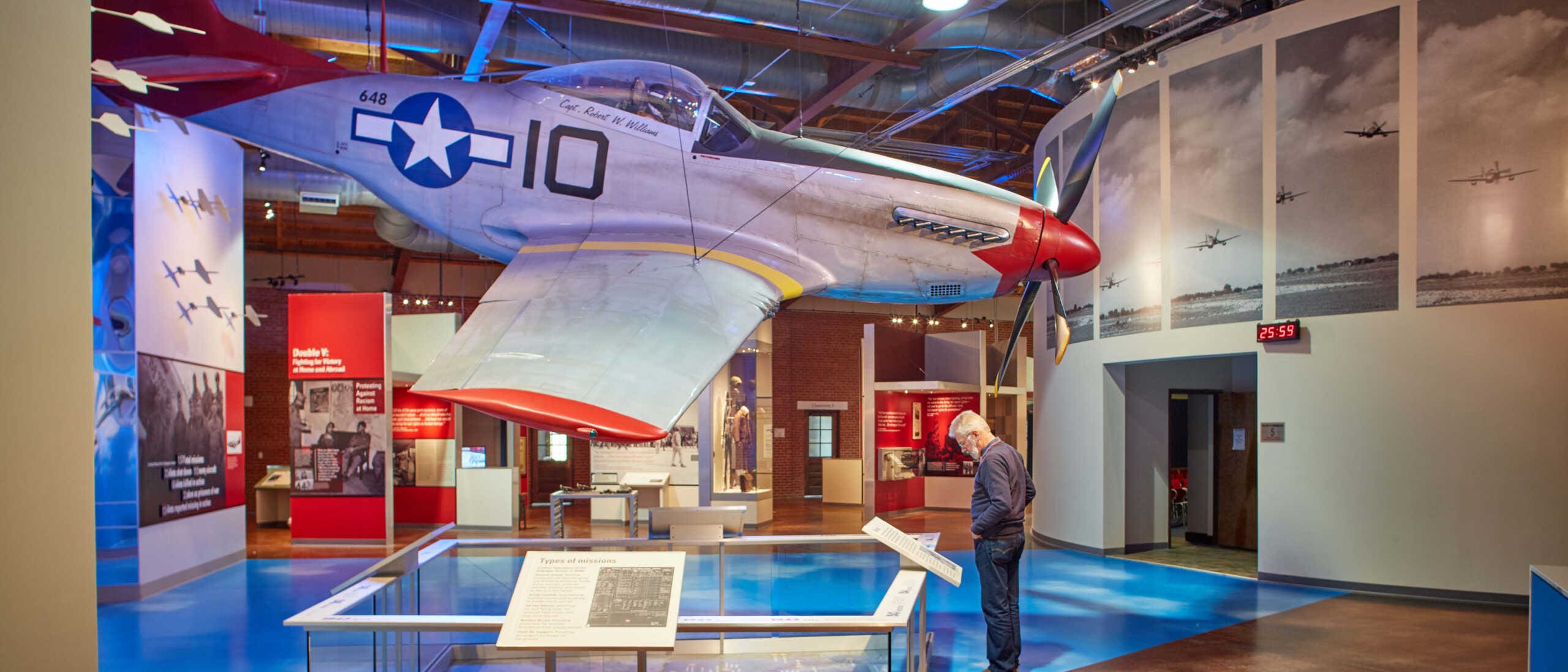
The Tuskegee Airmen were the first African American military aviators in the U.S. Armed Forces. During World War II, they trained at the then-segregated Moton Field in Tuskegee, which today stands as a national historic site to honor the trailblazing pilots’ bravery and service.
Through free, accessible exhibits, including up-close access to original WWII-era aircraft, the Tuskegee Airmen National Historic Site preserves the powerful legacy of the airmen. Guests can stroll through restored hangars and view aviation memorabilia and artifacts for insights into the pilots’ role in World War II — and in dismantling service barriers within the U.S. military more broadly.
“Our mission is to honor the bravery and contributions of the airmen by sharing their stories with the public and inspiring future generations,” a National Park Service museum spokesperson said.
During the war, the airmen — called the Red Tails, in a nod to their habit of painting their P-51 Mustang tailfins red — drew acclaim for never losing a bomber they escorted. Their exceptional flight skills directly challenged long-standing racial prejudices about the presumed inferiority of Black pilots and helped pave the way for President Truman’s 1948 executive order to desegregate the armed forces.
While in Tuskegee, groups can also explore the Tuskegee Institute National Historic Site, which includes the historic home of Booker T. Washington and a museum devoted to the life and work of famed scientist and inventor George Washington Carver.


Robin Roenker
Freelance writer Robin Roenker reports on travel, healthcare and higher education for regional and national outlets including Group Travel Leader, AARP, Southern Living, USA TODAY and more. She lives in Lexington, KY, with her husband, three sons, and very energetic dog, Ollie.
You May Also Like



About Us

We're The Group Travel Leader, America's leading experts on all things group travel. Find hundreds of articles, podcasts and other free resources for your group travel program here.
The Latest Issue
Stay Connected!
Get the Group Travel Minute e-newsletter twice a month.